
EPL Standings: Latest Premier League Table and Club Positions

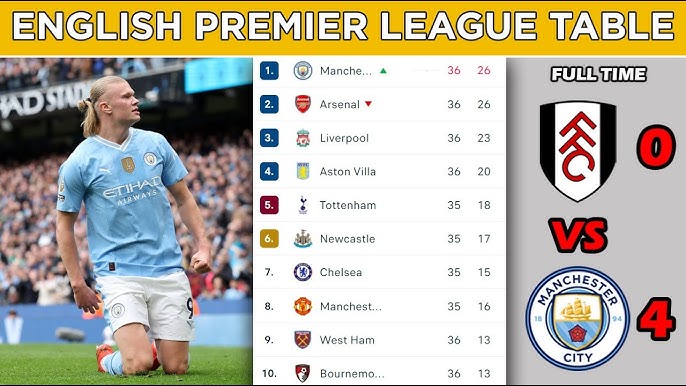
The English Premier League standings show how each club is performing across the season. Often called the EPL table, the standings are updated after matches are played and give supporters a quick snapshot of the title race, European qualification places and relegation battle.
Because results can change the table from week to week, check a live standings page for the latest positions. Here’s what the numbers mean and how clubs move up or down the table.
What the columns mean
- Club: The team’s name.
- P: Matches played.
- W: Wins.
- D: Draws.
- L: Losses.
- GF: Goals scored.
- GA: Goals conceded.
- GD: Goal difference — goals scored minus goals conceded.
- Pts: League points.
How Premier League points work
A team earns three points for a win, one point for a draw and no points for a loss. Clubs are ranked by their total points. That makes every result important: a late goal can turn a draw into a win, while a defeat can leave a team vulnerable to being overtaken.
What happens when clubs are level?
If two or more clubs have the same number of points, the usual ranking order is goal difference, followed by goals scored. For example, a club that has scored 50 goals and conceded 30 has a goal difference of +20.
If clubs remain level on the relevant measures and the position affects the title, qualification for a competition or relegation, the Premier League may use a play-off to decide the final ranking.
Why positions in the table matter
The club finishing top of the standings is crowned Premier League champion. Places near the top can bring qualification for European competitions, although the number of places and which competitions they lead to can vary between seasons.
At the other end of the table, the three clubs finishing in the bottom positions are relegated to the Championship, England’s second tier. The three promoted clubs then take their places in the following Premier League season.
Why the table can be misleading mid-season
Not every club has always played the same number of matches. Postponements, cup commitments and the fixture schedule can leave teams with games in hand. A club sitting lower in the standings may have an opportunity to gain ground, but those matches still need to be won.
It’s also worth looking beyond a team’s position. Points per match, recent results, goal difference and upcoming fixtures can all provide useful context. A narrow gap between clubs may disappear after one round of matches, while a strong goal difference can be valuable when teams finish level on points.
Following the EPL standings
For the clearest picture, check the Premier League table alongside recent results and upcoming fixtures. The standings tell you where each club sits; the match schedule helps explain what might happen next.
EPL Standings Explained: 6 Tips for Understanding the Ladder
- Check points first; the highest total leads the table.
- Wins earn three points, draws one and losses none.
- Goal difference breaks ties on points.
- The top four usually qualify for the Champions League.
- The bottom three are relegated to the Championship.
- Standings can change after every matchweek.
Check points first; the highest total leads the table.
When checking the EPL standings, start with the points column: the club with the highest total sits at the top of the table. Teams earn three points for a win, one for a draw and none for a loss, so each result can shift the rankings as the season progresses.
Wins earn three points, draws one and losses none.
In the EPL standings, a win earns a club three points, a draw adds one point and a loss earns none. These points determine each team’s position on the table, so every result can make a difference to the title race, European qualification or the fight to avoid relegation.
Goal difference breaks ties on points.
When two or more clubs have the same number of points in the EPL standings, goal difference is used to separate them. It’s calculated by subtracting the goals a team has conceded from the goals it has scored, so a higher goal difference gives a club the advantage. That’s why scoring goals and defending well can matter right to the end of the season—even when teams have won the same number of points.
The top four usually qualify for the Champions League.
The top four clubs in the EPL standings usually qualify for the following season’s Champions League, making a place in the top four one of the Premier League’s key targets. However, the number of qualifying places can vary under UEFA’s rules, so check the arrangements for the relevant season.
The bottom three are relegated to the Championship.
The bottom three clubs in the EPL standings at the end of the season are relegated to the Championship, England’s second tier. Relegation can have a major impact on a club, affecting its finances, squad and prospects for the following season, while the top three Championship clubs earn promotion to the Premier League.
Standings can change after every matchweek.
EPL standings can change after every matchweek, as each result affects clubs’ points, goal difference and position on the table. A win can lift a team several places, while a loss may pull it closer to the relegation zone or make the race for European qualification more difficult. That’s why it’s worth checking the latest table after each round of matches.
EPL standings: how to read the Premier League table The English Premier League standings show how each club is performing across the season. Often called the EPL table, the standings are updated after matches are played and give supporters a quick snapshot of the title race, European qualification places and relegation battle. Because results can…