
How to Write a Clear and Effective Report

What Is a Report?
A report is a structured account of information, findings or events, prepared to help readers understand a subject and, in many cases, decide what to do next. Reports are used in workplaces, schools, government and community organisations. They can cover anything from project progress and customer feedback to scientific research and financial performance.
Why Reports Matter
Good reports make information easier to assess. Rather than presenting disconnected facts, they organise evidence around a clear purpose. A well-prepared report can explain what has happened, identify patterns or problems, and recommend practical next steps.
Reports also create a record that others can refer to later. This is particularly useful when decisions need to be explained, progress needs to be tracked or several people are working on the same issue.
Common Types of Reports
- Progress reports summarise work completed, current challenges and upcoming tasks.
- Research reports present a question, describe the method used to investigate it and explain the findings.
- Incident reports document what happened, when it happened and what actions were taken.
- Business reports examine areas such as operations, sales, finances or customer experience.
- Inspection reports record observations about a site, product, process or service.
What Makes a Report Effective?
An effective report is clear, relevant and supported by reliable information. It should be written for its intended readers: a technical audience may need detailed methods and data, while senior decision-makers may need a concise summary and clear recommendations.
Accuracy is essential. Facts, figures and quotations should be checked, and sources should be identified where appropriate. It is also important to distinguish evidence from opinion. If information is incomplete or uncertain, the report should say so rather than present assumptions as facts.
A Practical Structure
The right format depends on the report’s purpose, but many reports include the following sections:
- Title: States the subject and, where useful, the date or reporting period.
- Executive summary: Gives a brief overview of the purpose, main findings and recommendations.
- Introduction: Explains the background, scope and questions the report addresses.
- Method: Describes how information was collected or assessed.
- Findings: Presents the evidence in a logical order, using headings, tables or charts where helpful.
- Discussion: Explains what the findings mean and notes any limitations.
- Conclusion and recommendations: Summarises the key message and proposes appropriate actions.
- References or appendices: Lists sources and provides supporting material when needed.
Writing and Reviewing a Report
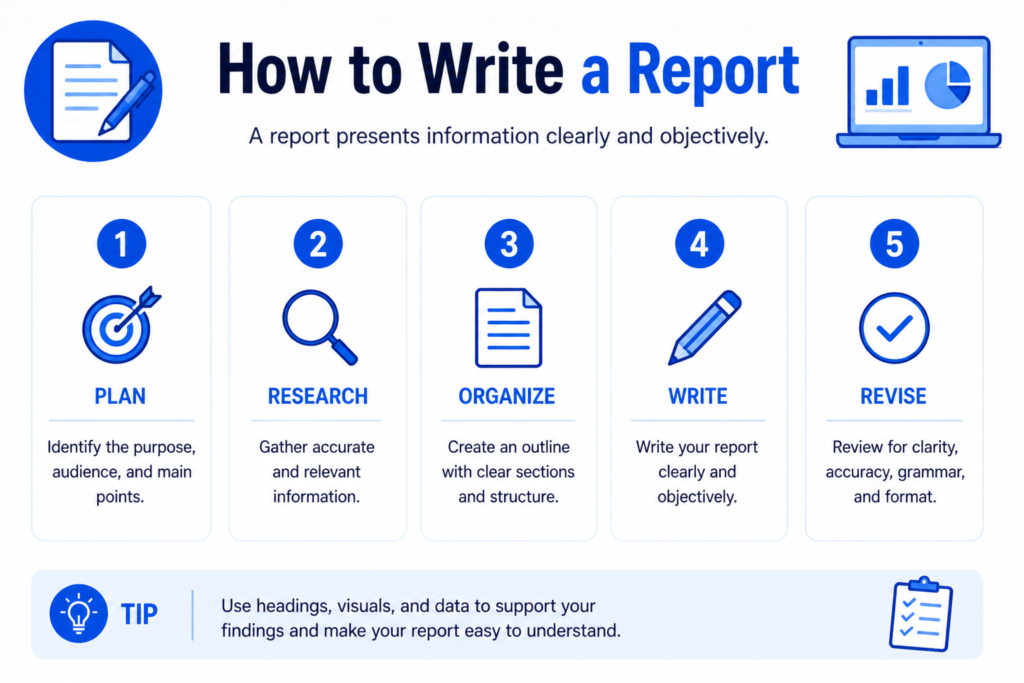
Start by defining the report’s purpose and the questions it needs to answer. Gather relevant information, check its quality and plan the sections before drafting. Use plain language, short paragraphs and descriptive headings so readers can find key points quickly.
Before sharing the report, review it for accuracy, structure and tone. Check that each conclusion follows from the evidence, that recommendations are practical and that charts or tables are labelled clearly. A final proofread can catch spelling, grammar and formatting errors that might distract from the content.
In Summary
A report is more than a collection of facts. It is a way to organise information so people can understand a situation and make informed decisions. By choosing a clear purpose, using trustworthy evidence and presenting findings in a logical format, writers can make reports useful, accessible and action-focused.
8 Tips for Writing a Clear and Effective Report
- Know your audience and purpose.
- Use a clear, descriptive title.
- Organise ideas with headings.
- Keep sentences short and clear.
- Support claims with reliable evidence.
- Use Australian spelling and punctuation.
- Check facts, figures and sources.
- Proofread before submitting.
Know your audience and purpose.
Before you start writing a report, be clear about who will read it and what they need to know. A report for senior decision-makers may call for a concise summary and practical recommendations, while a technical audience may need detailed methods and evidence. Keeping your purpose in mind helps you choose the right information, tone and level of detail, so readers can quickly understand the key points and take the next step.
Use a clear, descriptive title.
Use a clear, descriptive title so readers can quickly understand what your report covers. Include the main subject and, where relevant, the project name, location or reporting period. A specific title such as “Community Survey Results: October 2026” is more useful than a vague one like “Report”.
Organise ideas with headings.
Use clear, descriptive headings to organise a report into sections and guide readers through your ideas. Headings make information easier to scan, help readers find specific details and show how each point relates to the overall topic. Keep them concise and make sure each one accurately reflects the section that follows.
Keep sentences short and clear.
Keep sentences short and clear so readers can follow your report easily. Focus on one main idea at a time, choose familiar words and remove unnecessary detail. This makes your key findings and recommendations easier to understand.
Support claims with reliable evidence.
Support claims with reliable evidence to make your report accurate and convincing. Use trustworthy sources such as official data, peer-reviewed research or first-hand records, and make it clear where the information comes from. Check that each source is relevant and up to date, and distinguish verified facts from assumptions or opinions.
Use Australian spelling and punctuation.
When writing a report for an Australian audience, use Australian spelling and punctuation consistently. Prefer forms such as “analyse”, “organise”, “centre” and “colour”, and follow the organisation’s style guide for dates, quotations and abbreviations. Consistency makes the report easier to read and helps it feel polished and appropriate for its intended readers.
Check facts, figures and sources.
Before submitting a report, check every fact, figure and source. Confirm that statistics are accurate and up to date, calculations are correct, and quotations or claims are attributed to reliable sources. Careful checking helps build trust, prevents misunderstandings and ensures readers can verify the information for themselves.
Proofread before submitting.
Before submitting a report, take time to proofread it carefully. Check spelling, grammar, punctuation and formatting, and make sure names, dates and figures are correct. Reading the report aloud or taking a short break before reviewing it can help you spot errors you might otherwise miss. A polished report is easier to understand and makes a more professional impression.
What Is a Report? A report is a structured account of information, findings or events, prepared to help readers understand a subject and, in many cases, decide what to do next. Reports are used in workplaces, schools, government and community organisations. They can cover anything from project progress and customer feedback to scientific research and…